

Industrial 3D Printing Services for Prototypes and Production

ZigiTech helps product teams move from concept models to production-ready printed parts with practical process guidance, engineering-grade materials, and quality-controlled manufacturing support.

  • Rapid prototypes, bridge builds, and low-volume production support
  • Engineering guidance across polymer and metal additive workflows
  • Process matching for FDM, SLA, SLS, SLM, and MJF applications
Get Instant Quote
All file uploads are fully secured and kept strictly confidential.
Industrial 3D printed lattice component
Amtivo certification logo
ISO 9001:2015 certification icon
AS9100D certification icon
0 +
engineering-grade metals and plastics
0
core additive process options
ISO
quality-controlled production workflow

Our 3D Printing Services

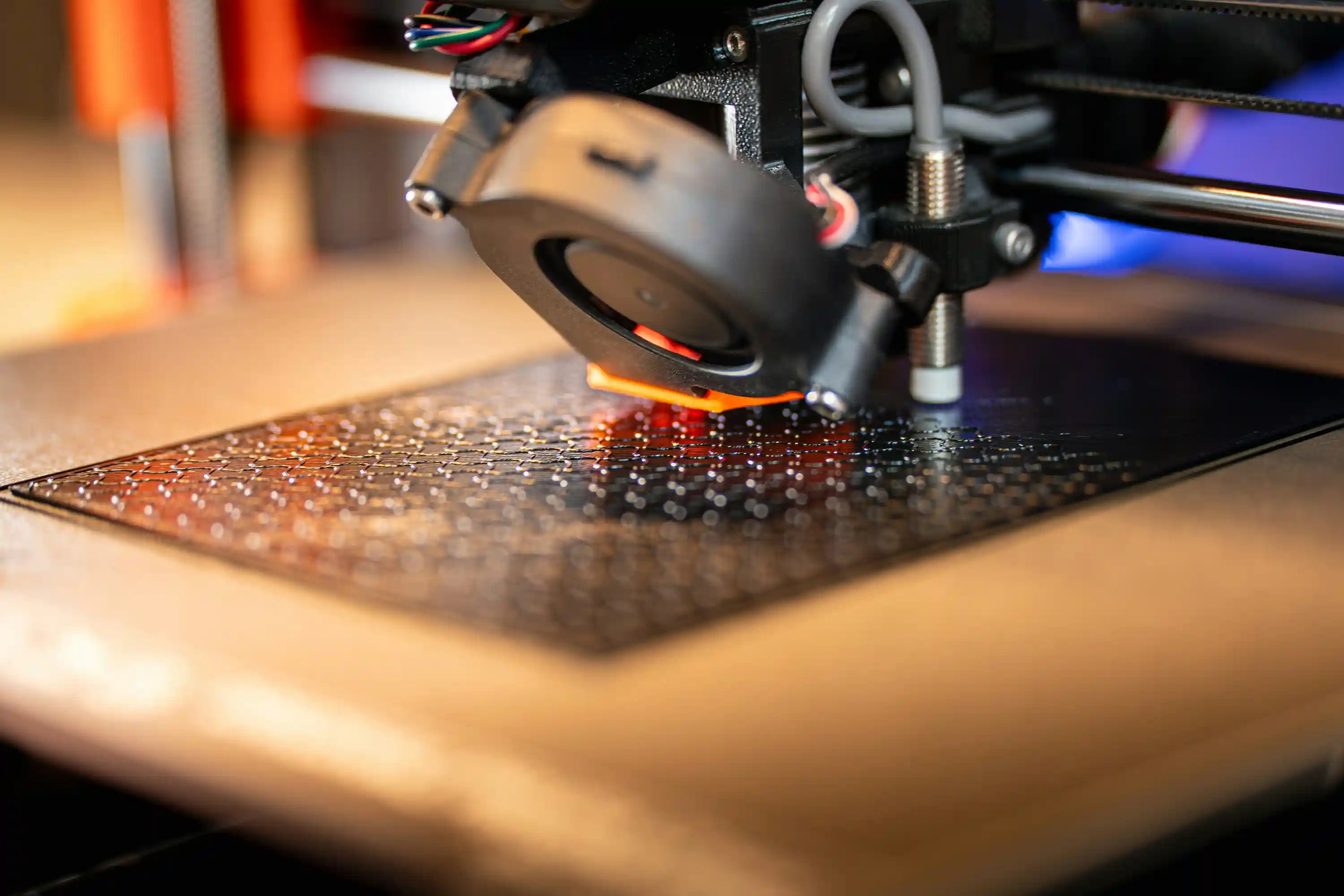
Close-up of an FDM 3D printer building a prototype layer by layer

ZigiTech delivers reliable 3D printing services to support every stage of product development, from early prototypes to short-run production. Whether you need functional parts for testing or accurate end-use components, we manufacture custom printed parts on demand with responsive lead times and stable process control.

We work with over 20 engineering-grade metals and plastics and guide customers to the most practical additive route for each geometry, performance target, and budget. Our in-house team supports widely used processes including selective laser sintering (SLS), fused deposition modeling (FDM), stereolithography (SLA), selective laser melting (SLM), and Multi Jet Fusion (MJF).

For buyers looking for a Manufacturing Service partner or a machinery parts manufacturer with additive capability, we combine additive expertise, production-minded review, and disciplined quality checks so every printed part arrives aligned with your drawing intent and application needs.

Below is a quick overview to help you select the right 3D printing process based on part function, material, and production needs.

FDM 3D Printing Service

Best for: Affordable functional prototypes and large-format visual models.

FDM is a cost-effective option for rapid design validation, fixture concepts, and larger-format plastic parts. Using materials such as ABS, PC, and PLA, we support projects where practical iteration speed and competitive pricing matter most.

Get Instant Quote
FDM 3D printed fixture-style component

SLA 3D Printing Service

Best for: High-definition visual prototypes and parts with fine details.

SLA produces smooth-surfaced resin parts with excellent detail resolution, making it a strong choice for presentation models, transparent components, and master patterns used ahead of vacuum casting or cosmetic review.

Get Instant Quote
Transparent SLA resin prototypes displayed after printing

SLS 3D Printing Service

Best for: Durable functional parts and complex assemblies.

SLS uses nylon powder and laser sintering to create strong parts without support structures. That makes it well suited to load-capable housings, interlocking features, and production-ready prototypes with complex internal geometry.

Get Instant Quote
SLS lattice spheres showing nylon additive manufacturing capability

SLM 3D Printing Service

Best for: High-performance, end-use metal components.

SLM fully melts fine metal powder to produce dense aluminum, stainless steel, and titanium parts for demanding applications. It is ideal when conventional machining cannot achieve the required geometry or weight-saving structure.

Get Instant Quote
Complex metal SLM additive structure with open geometry

MJF 3D Printing Service

Best for: Production-grade nylon parts and small-batch manufacturing.

MJF delivers consistent nylon parts with good dimensional control and efficient throughput for repeatable batches. We recommend it for functional prototypes, production aids, and low-volume part programs that need balanced speed, accuracy, and mechanical performance.

Get Instant Quote
MJF-style nylon component with lightweight cellular geometry

Why Choose ZigiTech for 3D Printing?

ZigiTech supports a broad range of additive manufacturing technologies, including FDM, SLA, SLS, SLM, MJF, and metal 3D printing workflows. Here is how we help customers move faster, control cost, and reach stable part quality from prototype validation through production planning.

Responsive manufacturing support

ISO 9001:2015 certification logo

ISO 9001:2015 controlled workflow

01

Rapid Turnaround 3D Printing

Upload your 3D CAD files and our team can review manufacturability, process fit, and lead time quickly. From single functional prototypes to repeat batches, ZigiTech keeps scheduling practical so product teams can move without unnecessary delay.

02

Prototype to Production

We support a clean transition from one-off prototypes to scalable low-volume manufacturing. Whether your program needs 10 parts or 1,000 units, our additive workflows help maintain production-minded quality without the tooling burden of traditional molding routes.

03

Dedicated DFM Support

Our engineers provide DFM guidance on orientation strategy, material selection, wall condition, tolerance planning, and finishing decisions. That early review helps printed parts perform better in testing and stay more stable as volumes increase.

04

3D Printing Quality Assurance

ZigiTech follows an ISO 9001:2015 quality-controlled workflow across material checks, in-process review, and final dimensional verification. When required, we coordinate inspection records and first-article reporting to keep projects aligned with customer expectations.

Prototype to Part, Without the Delay

Selected simple parts from 10 mm x 10 mm to 200 mm x 200 mm can move on a standard 3-day lead time. Upload your file to check whether it fits the program.
01

Submit Your CAD Files

Send over your design and get the review process moving immediately.

Upload CAD files and project requirements.
02

Live Quote with DFM Insight.

Receive pricing fast, together with manufacturability input from our team.

Review instant pricing and DFM guidance.
03

Approve for Production.

Confirm the key specs so your order can enter the manufacturing queue.

Approve manufacturing details before production starts.
04

Parts Ship Out.

Your completed components are packed, checked, and released for delivery.

Finished parts prepared for shipment.

3D Printing Technologies Compared

Selecting the right technology is critical to both functional performance and cosmetic expectations. Use this comparison guide to review accuracy, standard materials, and lead time so your team can match the right Manufacturing Service process to the application.
Feature / Process FDMSLASLSMJFSLM
Advantages
  • Most cost-effective
  • Scalable for large parts
  • Good structural strength
  • Superior surface finish
  • High feature resolution
  • Ideal for clear parts
  • No support structures
  • Isotropic properties
  • Ideal for complex geometries
  • Production-grade nylon
  • Isotropic strength
  • High-speed batch builds
  • High-strength metal parts
  • Near-wrought density
  • Excellent thermal resistance
Limitations
  • Visible layer lines
  • Lower accuracy
  • Anisotropic strength
  • Brittle materials
  • Degrades with UV or sunlight
  • Mostly for visual models
  • Grainy surface texture
  • Limited color options
  • Slight porosity
  • Higher cost than FDM
  • Matte, slightly grainy finish
  • Limited to certain polymers
  • Highest cost per part
  • Extensive post-processing
  • High thermal stress
Standard Materials

ABS, PC, PLA, PET

Photopolymer resins

Nylon (PA11, PA12)

Nylon (PA12, glass-filled)

Stainless steel, titanium, aluminum

Accuracy

+-0.5% (min +-0.5 mm)

+-0.1 mm

+-0.3 mm

+-0.3 mm

+-0.1 to 0.2 mm

Typical Layer Height

50 to 400 microns

25 to 100 microns

100 to 120 microns

80 microns

20 to 50 microns

Est. Lead Time

3 business days

3 to 5 business days

5 business days

5 business days

7 to 10 business days

Applications of 3D Printing

3D printing supports faster development across multiple industries by shortening iteration cycles and enabling production-ready geometry that would be difficult or expensive to build with conventional methods alone. ZigiTech helps teams apply additive manufacturing where weight reduction, customization, and rapid validation create clear value.

Medical

Medical 3D printing supports anatomical models, surgical planning tools, device development, and low-volume custom components where geometry accuracy and fast iteration both matter.

View Medical Applications
Medical industry applications for industrial 3D printing

Aerospace

Aerospace teams use additive manufacturing for lightweight brackets, ducting, tooling aids, and development-stage flight hardware with geometry that benefits from mass reduction.

View Aerospace Applications
Aerospace industry applications for industrial 3D printing

Robotics and Automation

3D printing helps robotics programs produce lightweight housings, grippers, fixtures, and multifunctional assemblies that shorten integration cycles and simplify custom builds.

View Robotics Applications
Robotics and automation applications for industrial 3D printing

Automotive

Automotive teams rely on additive workflows for functional prototypes, airflow studies, custom jigs, fixtures, and lightweight part concepts before committing to hard tooling.

View Automotive Applications
Automotive industry applications for industrial 3D printing

Industrial

Industrial machinery programs use 3D printing to validate part fit, reduce setup tooling cost, and create low-volume components where customization and fast replacement matter.

View Industrial Applications
Industrial machinery applications for industrial 3D printing

Consumer Products

Consumer product teams use rapid prototyping to refine enclosure design, ergonomics, and assembly decisions while keeping development cycles moving before injection mold tooling starts.

View Consumer Product Applications
Consumer product applications for industrial 3D printing

3D Printing Design Specifications and Tolerances

Understanding design limits and process tolerances early helps teams avoid costly geometry revisions later. Use this guide to compare feature size, wall thickness, and recommended tolerance ranges when planning parts for production or prototype release.
Printing Process Minimum Feature Size Minimum Wall Thickness Recommended Design Tolerance Suitable Applications
FDM ~0.4 mm 0.8 to 1.2 mm +-0.2 to +-0.5 mm Concept models, large shell parts, rapid prototyping
SLA ~0.2 mm 0.4 to 0.6 mm +-0.05 to +-0.1 mm Precision models, display models, medical models
SLS ~0.5 mm 0.8 to 1.0 mm +-0.2 mm (<100 mm), +-0.3% (>100 mm) Functional parts, small-batch plastic parts, and assemblies
MJF ~0.5 mm 0.6 to 1.0 mm +-0.3 mm (or +-0.3% for larger parts) Production-grade parts, housings, and complex functional assemblies
SLM / DMLS ~0.3 mm 0.8 to 1.5 mm +-0.05 to +-0.1 mm High-performance metal parts, molds, aerospace and medical parts

FAQ

3D printing builds objects layer by layer from a digital 3D model, which is why the method is commonly described as additive manufacturing. Instead of cutting material away, the process deposits or fuses only the material needed to create the final geometry, making it well suited to complex shapes and fast design iteration.
3D printing cost depends on process choice, part size, material, layer thickness, finishing requirements, and order quantity. FDM usually offers the lowest entry cost, while SLS, MJF, and metal printing are priced according to build volume, material grade, and inspection needs. ZigiTech reviews CAD data and project requirements before confirming lead time and quotation details.
Create your model in CAD software such as Fusion, SolidWorks, or similar engineering tools, then export a manufacturing-ready file in formats like STL or STEP. Before upload, check wall thickness, dimensions, watertight geometry, and any unsupported features. Our team reviews files after submission and can provide guidance if the model needs adjustment for FDM, SLA, SLS, MJF, or metal printing.
3D printing is especially valuable for prototypes, custom parts, and low-volume production because it reduces tooling dependency, shortens iteration cycles, and supports geometry that can be difficult to machine or mold. Compared with conventional manufacturing, it can also reduce material waste and speed up validation before full production investment.
Verified Client Feedback
Trusted by teams shipping precision parts under real production deadlines.

The bent sheet metal parts arrived with hardware installed correctly and no confusion against the drawing set. Receiving and inspection both went smoothly.

Julia Novak Procurement Specialist, Czech industrial controls supplier

We needed stainless parts for a lab instrument where cosmetic defects would have caused trouble during final assembly. The batch looked clean and consistent.

Andrew Price Senior Engineer, UK analytical equipment company

We appreciated the order discipline as much as the parts themselves. Material confirmation, shipment notice, and invoice timing were all aligned, which is not always the case.

Isabella Torres Supply Chain Manager, Mexican automation OEM

One prototype project used additive for speed and machining for the mating features. Their team was clear about why that split made sense instead of pushing one route for everything.

Samuel Reed NPI Engineer, US aerospace interiors supplier

We needed someone who could support early samples and then stay with us through short production runs. That continuity matters once procurement takes over from engineering.

Clara Dubois Commodity Manager, French mobility components company

The soft-tool parts were presentable enough for customer meetings, which helped us bridge an awkward phase before production tooling was ready.

Ryan Patel Product Development Engineer, Canadian healthcare startup

Our order was not large, but the drawing notes and dimensional callouts were still handled carefully. That gave us confidence to come back with a bigger program later.

Georgia Hunt Lab Operations Lead, Australian energy research team

Packaging held up well during international transit, which was one of our concerns on a mixed metal parts order. Nothing arrived loose or confused in the box.

Rafael Mendes Purchasing Supervisor, Brazilian machinery supplier

Put your parts into production today

All information and uploads are secure and confidential.

Get Instant Quote

Upload

Quote

Confirm

Ship

Supports:

STEPSTPSLDPRTIPTPRTSATIGESIGSCATPARTX_TOBJSTL