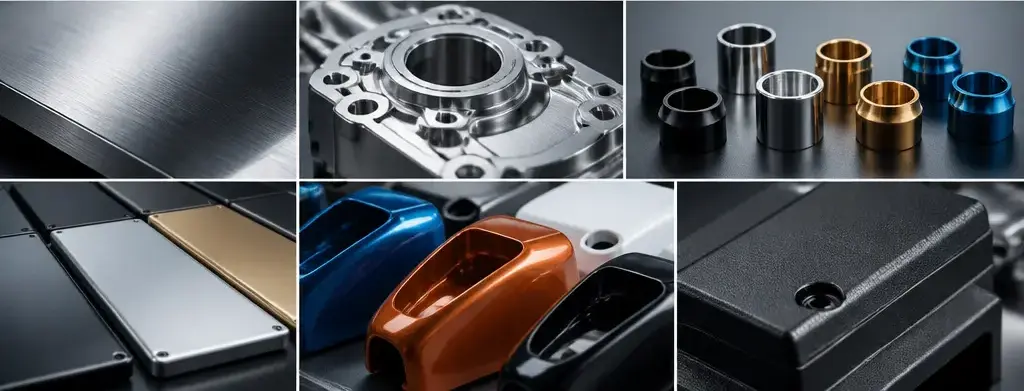
Affinage mécanique
Utilisé lorsque l'objectif est le lissage, l'ébavurage ou l'établissement d'une texture visible uniforme.
- Tel que usiné
- Ponçage
- Sablage
- Grenaillage
- Barillage
- Polissage
- Finition brossée

Utilisé lorsque l'objectif est le lissage, l'ébavurage ou l'établissement d'une texture visible uniforme.
Choisies pour la résistance à la corrosion, la durée de vie en usure, les exigences de conductivité ou la performance d'assemblage en aval stable.
Appliqués lorsque le projet nécessite couleur, cohérence décorative ou couverture de surface plus large sur un lot.
| Finition | Usage principal | Service | Applicable à | Traces d'usinage |
|---|---|---|---|---|
| As Machined | Baseline finish that leaves the part in its machined state. It is a practical choice when speed, cost control, and dimensional consistency matter more than cosmetic refinement. | CNC machining, Sheet metal fabrication | Metals, Plastics | Visible, light surface scratches |
| Sanding | Abrasive smoothing process that removes minor imperfections and prepares parts for a finer final finish. | CNC machining | Metals, Plastics | Reduced but visible |
| Sand Blasting | A blasting process that removes coatings and contaminants while creating a uniform, slightly abrasive surface texture. | CNC machining, Sheet metal fabrication | Metals, Plastics | Uniform roughness, slightly abrasive feel |
| Bead Blasting | Glass bead blasting produces a more even matte or satin appearance while softening the look of machining marks. | CNC machining, Sheet metal fabrication | Metals, Plastics | Matte or satin surface |
| Tumbling | A barrel or vibratory finishing process that smooths edges and improves surface consistency across batches. | CNC machining, Sheet metal fabrication | Metals, Plastics, Glass | Reduced and smoothed |
| Polishing | A finishing process that reduces roughness and creates a smoother, brighter, or mirror-like surface. | CNC machining, Sheet metal fabrication | Metals, Plastics | Glossy or mirror-like finish |
| Brushed Finish | Directional mechanical finishing that creates a consistent satin grain on metal surfaces. | CNC machining, Sheet metal fabrication | Metals | Reduced for non-cosmetic, removed on primary surfaces for cosmetic |
| Anodizing | Electrochemical treatment that thickens the oxide layer on aluminum and improves corrosion resistance. | CNC machining, Sheet metal fabrication | Aluminum, Titanium | Reduced for non-cosmetic, removed on primary surfaces for cosmetic |
| Hard Anodizing | Harder anodizing option for aluminum parts when wear resistance and surface durability matter more than cosmetic flexibility. | CNC machining, Sheet metal fabrication | Aluminum | Visible under anodizing |
| Chromate Conversion Coating | Chemical treatment for aluminum and magnesium alloys that improves corrosion resistance and paint adhesion. | CNC machining, Sheet metal fabrication | Aluminum, Magnesium alloys | Visible |
| Black Oxide | Chemical coating for ferrous metals that creates a thin black oxide layer and improves corrosion resistance. | CNC machining, Sheet metal fabrication | Steel, Iron | Visible |
| Electroless Nickel Plating | Autocatalytic metal coating that produces uniform coverage and improves corrosion resistance on complex geometry. | CNC machining, Injection molding, 3D printing | Metals, Plastics | Partially hidden |
| Nickel Plating | Nickel coating applied by electroplating to improve appearance, wear behavior, and corrosion resistance. | CNC machining, Sheet metal fabrication | Steel, Copper, Brass, Aluminum | Partially hidden |
| Electroplating | Electrically driven process that deposits a metallic coating onto conductive parts for protection or appearance. | CNC machining, Sheet metal fabrication | Metals | Partially hidden |
| Zinc Plating | Thin zinc coating used to improve corrosion resistance and appearance on steel and iron parts. | CNC machining, Sheet metal fabrication | Steel, Iron, Brass | Partially hidden |
| Powder Coating | Dry coating process that cures into a durable finish with color, texture, and strong wear resistance. | CNC machining, Sheet metal fabrication, Injection molding | Metals, Some Plastics | Removed |
| Painting | Liquid coating finish used for color, texture, and protective coverage across metal and plastic parts. | CNC machining, Sheet metal fabrication, Injection molding, 3D printing | Metals, Plastics, Wood | Partially visible |
| Electrophoresis | Coating process using charged particles in a bath to form a uniform finish on conductive parts. | CNC machining, Sheet metal fabrication | Metals, Ceramics | Hidden |
| Passivation | Chemical treatment that removes free iron and improves corrosion resistance on stainless steel and similar alloys. | CNC machining, Sheet metal fabrication | Stainless Steel, Other Corrosion-resistant Alloys | Visible |
| Teflon Coating | PTFE-based protective coating that lowers friction and improves release and corrosion resistance. | CNC machining, Sheet metal fabrication, Injection molding | Metals, Plastics | Visible |
| Heat Treatment | Thermal process used to change mechanical properties such as hardness, strength, and ductility. | CNC machining | Metals | Visible |
| SPI Finish | Standardized plastic surface texture system ranging from glossy to matte for injection molded parts. | Injection molding | Plastics | Visible |
| Tinted | Coloring option for plastic prototypes that adds a translucent or uniform color appearance without full painting. | 3D printing, Injection molding | ABS, PMMA, PC, PS | Visible |
| Chrome Plating | Decorative and functional metal coating used to improve appearance, hardness, and corrosion resistance. | CNC machining, Sheet metal fabrication | Metals | Partially hidden |
Pour les pièces grand public ou de marque visibles, nous commençons par examiner la préparation de surface, les cibles de couleur et où les traces d'usinage peuvent ou non rester visibles.
Pour le matériel industriel et extérieur, la finition est sélectionnée selon la résistance à la corrosion, la friction, la conductivité et l'environnement de service plutôt que l'apparence seule.
Certaines finitions ajoutent de l'épaisseur de surface ou nécessitent une planification dimensionnelle pré-finition. Nous signalons ces contraintes avant la production pour que les pièces finies s'assemblent encore correctement.
Cela dépend à la fois du matériau et du type de qualité visuelle dont vous avez besoin. Pour l'aluminium, l'anodisation est un choix courant. Pour la quincaillerie en acier visible, les finitions brossées, plaquées ou revêtues peuvent être meilleures. Pour les plastiques moulés, la texture SPI et la peinture comptent souvent plus qu'une finition en aval distincte. La bonne réponse vient de l'examen conjoint du matériau, de la géométrie et des faces cosmétiques de la pièce.
Certaines oui. Les affinages mécaniques comme le sablage ont généralement un effet dimensionnel limité, tandis que les revêtements et placages peuvent ajouter de l'épaisseur. C'est pourquoi ZigiTech examine les ajustements critiques, filetages, zones masquées et surfaces d'appui avant de figer une finition en production.
Oui. Nous examinons la compatibilité des finitions en usinage CNC, fabrication de tôle, service de moulage par injection plastique et processus prototypes sélectionnés. Certaines finitions sont pratiques sur de nombreuses routes de processus, tandis que d'autres n'ont de sens que pour une famille de matériaux ou de pièces restreinte.
C'est fréquent. Si vous connaissez déjà le matériau de la pièce, l'environnement attendu et si la pièce est cosmétique ou fonctionnelle, nous pouvons aider à resserrer rapidement l'ensemble des finitions et citer les options pertinentes. C'est souvent plus rapide que les essais et erreurs après la phase de premier article.
Toutes les informations et téléversements sont sécurisés et confidentiels.
Téléverser
Devis
Confirmer
Expédier
Formats pris en charge :